







Unveiling Shubh Muhurat: What is Auspicious Timing?
Ever felt that things just 'click' at certain moments? Or the opposite – that despite your best efforts, success seems elusive? In Vedic astrology, and indeed throughout Hindu culture, this isn't mere coincidence. It's the power of Muhurat – an auspicious window of time believed to amplify positive outcomes. After years of personally observing the impact of Muhurat, I'm convinced of its profound influence. Let's delve into what Shubh Muhurat truly is, why it matters, and how you can calculate it for yourself, using the Panchang as your trusted guide.
The Essence of an Auspicious Moment
The term 'Muhurat' literally translates to 'a moment' or 'an instant.' But it's far more than just any random moment on the clock. It refers to a specific, astrologically calculated period considered favorable for commencing important activities. Think of it as aligning yourself with the cosmic flow to maximize your chances of success and minimize potential obstacles. A Shubh Muhurat, therefore, is an especially auspicious Muhurat, deemed highly suitable for significant undertakings. It’s like finding that 'sweet spot' where the energies of the planets, lunar cycles, and other celestial factors converge harmoniously. Imagine trying to sail a boat against a strong current versus riding the waves – Shubh Muhurat is all about catching the favorable tide. I've noticed that even simple tasks yield better results when started during a Muhurat, and that’s why I always recommend checking the Panchang.
Why Shubh Muhurat Resonates So Deeply
The Cultural Heartbeat of Shubh Muhurat
Why is Shubh Muhurat so deeply ingrained in Hindu tradition? The answer lies in the belief that our actions are not isolated events but are interconnected with the universe. Choosing an auspicious time is a way of honoring this connection and inviting positive cosmic energies into our endeavors. Consider major life events like weddings – traditionally, immense care is taken to select a Shubh Muhurat for the ceremony. This is because the wedding is seen as a pivotal life transition, and starting it during a favorable time is believed to ensure a harmonious and prosperous union. The same principle applies to starting a new business, purchasing property, or even undertaking a long journey. I remember my grandmother meticulously consulting the Panchang before any major family event. Initially, I thought it was just superstition, but over time, I witnessed firsthand the positive outcomes that often followed. And it’s not just about avoiding bad luck; it’s about actively inviting good fortune.
The Panchang: Your Guide to Auspicious Times
Decoding the Panchang: Your Muhurat Compass
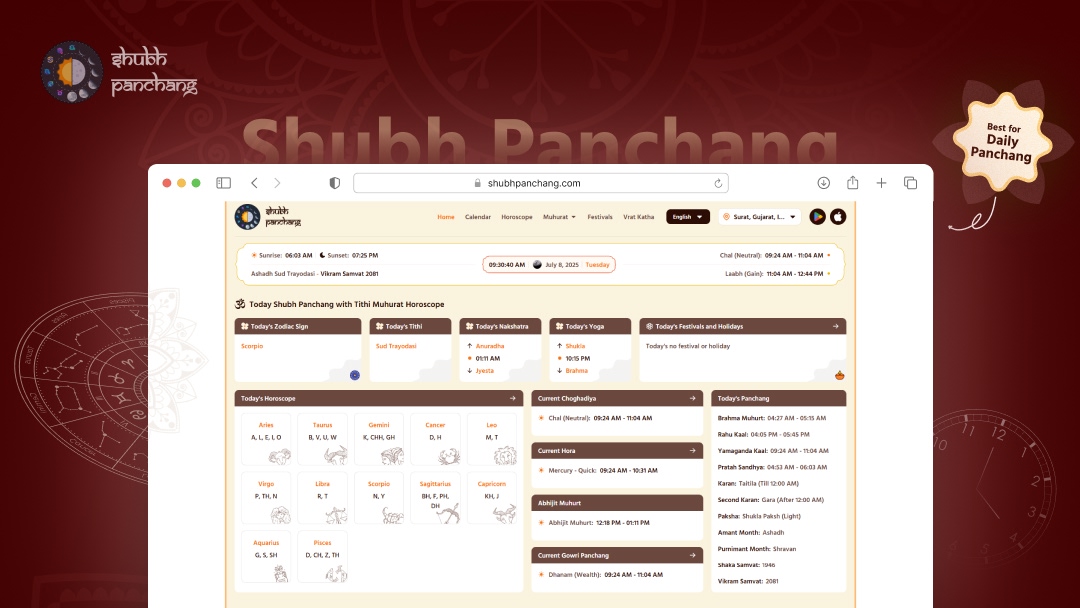
So, how do we pinpoint these auspicious times? That's where the Panchang comes in. The Panchang is a traditional Hindu almanac that details various astronomical elements, including Tithi (lunar day), Nakshatra (lunar mansion), Yoga (planetary combination), Karana (half lunar day), and Vaar (weekday). Each of these elements carries its own unique energy and influence. Calculating a Shubh Muhurat involves analyzing these elements to identify periods when they align favorably. Now, this might sound intimidating, but don't worry! Modern Panchangs are readily available, often in digital formats, making the process much easier.
Understanding the Panchang's Building Blocks
Elements of Panchang and Their Role:
- Tithi: The lunar day. Certain Tithis are considered more auspicious than others for specific activities. For example, the Ekadashi Tithi is considered highly favorable for spiritual pursuits.
- Nakshatra: The lunar mansion the Moon occupies. Each Nakshatra has unique characteristics and is associated with specific deities. Some Nakshatras are considered more auspicious for certain activities than others. For instance, Ashwini Nakshatra is considered auspicious for starting new ventures.
- Yoga: The combination of the Sun and Moon's longitudinal distances. Certain Yogas are considered beneficial, while others are deemed unfavorable.
- Karana: Half of a Tithi. There are 11 Karanas, and each has its own influence.
- Vaar: The weekday. Each day of the week is associated with a specific planet and carries its own energy. For example, Thursday is associated with Jupiter and is considered auspicious for learning and spiritual activities.
A Step-by-Step Guide to Finding Auspicious Moments
Calculating Shubh Muhurat: A Practical Approach
While the detailed calculations can be complex, requiring astrological expertise, here’s a simplified approach for identifying generally auspicious Muhurats:
- Consult a Panchang: Obtain a reliable Panchang, either physical or digital. Many online resources and apps provide Panchang details for specific locations and dates.
- Identify Auspicious Yogas and Nakshatras: Look for Yogas like Amrita Siddhi Yoga or Sarvartha Siddhi Yoga, which are generally considered highly auspicious. Similarly, certain Nakshatras like Rohini, Mrigashira, and Revati are often favored.
- Consider the Tithi: Shukla Paksha (the waxing phase of the Moon) Tithis are generally considered more auspicious than Krishna Paksha (the waning phase) Tithis.
- Avoid Rahu Kalam: Rahu Kalam is an inauspicious period that occurs daily, and it's generally advisable to avoid starting any new ventures during this time. Panchangs clearly indicate the Rahu Kalam timings for each day.
Remember, this is a simplified approach. For truly pivotal decisions, consulting a knowledgeable astrologer is always recommended. They can provide a personalized Muhurat calculation based on your birth chart and the specific nature of the activity.
The Missing Ingredient: Your Inner Guidance
Beyond the Formulas: Intuition and Intention
But here's the thing: while the Panchang provides a framework, it's not the only factor to consider. Your own intuition and intention also play a vital role. I've often found that when my heart feels aligned with a particular time, even if it's not technically the 'perfect' Muhurat, the results are still positive. Trust your gut feeling and approach your endeavors with a clear and positive intention. Ultimately, Shubh Muhurat is about aligning yourself with the cosmos, and that includes aligning with your own inner wisdom. After years of practice, I believe that combining both astrological knowledge and intuition brings the most rewarding result.
Your Journey to a More Aligned Life
Embrace the Power of Auspicious Timing
Shubh Muhurat is more than just a set of calculations; it's a way of life that encourages us to be mindful of the energies surrounding us. By consciously choosing auspicious times, we can enhance our efforts, minimize obstacles, and invite greater success and harmony into our lives. So, start exploring the Panchang, listen to your intuition, and embrace the power of auspicious timing. Your journey towards a more aligned and fulfilling life awaits! What if I told you that by simply paying attention to the cosmic timing, you could unlock a whole new level of success and well-being? It's time to find out!